
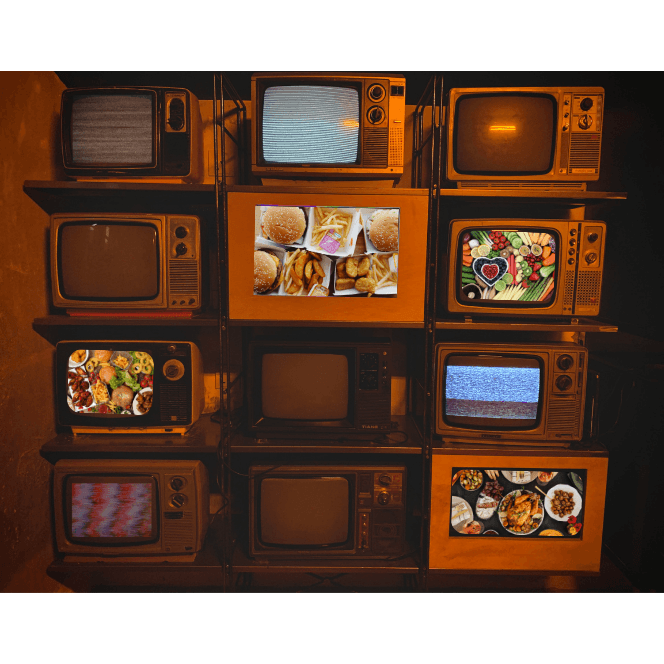
When celebrity-chef-led food programmes were criticised over a decade ago for blaming individuals rather than food systems, it was tempting to think public health television might eventually move on. Watching the first episode of What Not to Eat, it seems that it hasn’t. The narrative of individual responsibility remains firmly in place — only now it is delivered by scientific experts rather than chefs. Where figures such as Jamie Oliver once fronted moral lessons about “proper food,” those lessons are now articulated through the language of ultra-processing, biomarkers, and nutritional science, voiced by experts such as Professor Tim Spector. Therefore, the widely critiqued knowledge deficit model has not disappeared; it has simply been updated and repackaged. This post reflects on the programme’s first episode as a case study in how contemporary food television constructs “the public,” expertise, and responsibility.
The deficit model, again
In science and technology studies, the knowledge deficit model has long been criticised for imagining the public as empty vessels waiting to be filled with expert knowledge. Scholars such as Brian Wynne and Sheila Jasanoff have shown that public responses to science are shaped not just by information, but by trust, context, and lived experience. From this perspective, the problem is not ignorance but the gap between expert framings of risk and the practical realities of everyday life. This episode of What Not to Eat reproduces that older logic. It treats poor diet primarily as a failure of knowledge, rather than as something organised through time pressure, cost, exhaustion, and routine.
Dramatising the obvious
One of the most striking features of the programme is how it dramatises familiar dietary knowledge as if it were a scientific revelation. Viewers watch experts help an “ordinary” family discover that fruit is healthier than instant noodles — something most people already know. The scene is less nutritionally enlightening than sociologically revealing. The programme needs the public to appear uninformed in order for expert intervention to make sense. A more plausible explanation — that people often eat ultra-processed foods knowingly, because they are quick, cheap, and require little effort — remains largely off-screen.
Experts, everyday life, and moral judgement
The format relies on a familiar epistemological hierarchy between ‘expert’ and ‘lay’ knowledge. Scientific expertise is positioned as objective truth, while the family’s everyday understandings of food — shaped by children’s preferences, affordability, and tiredness — are treated as obstacles to be corrected. This risks confusing knowledge with the conditions required to act on it. The presenters’ language also shifts between describing ultra-processed food consumption as a “habit” and as an “addiction.” These are very different explanations of behaviour yet both locate the problem inside the household. Once expert knowledge has been delivered, the moral stakes rise. Continued consumption can now be read not as constrained, but as negligent. Education shades into judgement.
From advice to self-governance
This is where the analysis connects to power. As Michel Foucault argued and later developed by Nikolas Rose. Modern forms of power often work not through direct coercion, but by encouraging individuals to regulate themselves. Health television becomes a subtle technology of the self, inviting viewers to monitor, discipline, and optimise their own bodies in line with expert norms. Responsibility for managing risk is internalised, even when those risks are socially patterned.
“Busy lives” and the closing down of excuses
Professor Spector notes that despite having busy lives — work and children — the couple still managed to change their diets. On the surface, this is encouraging. Sociologically, however, it performs an important move. By acknowledging constraint only in order to overcome it, the programme sidelines structural explanations. “Busy lives” are treated as a shared, universal condition, rather than something shaped by inequality, job insecurity, caring responsibilities, and resources. The implicit message is not simply that change is possible, but that failure is inexcusable.
Structure, agency, and the kitchen
Drawing on Anthony Giddens’ theory of structuration, everyday practices like eating are shaped through the interplay of agency and structure. People make choices, but they do so within routinised conditions — working hours, domestic arrangements, and financial constraints — that both enable and limit what is realistically possible. Presenting dietary change as a simple matter of willpower detaches behaviour from the structured contexts in which it is organised. Even Professor Spector’s’ “simple swaps” rely on hidden assumptions. Fo example, a homemade sauce requires a blender, spare time, and confidence in cooking from scratch. These are not evenly distributed resources. The blender becomes a quiet symbol of how middle-class domestic norms are smuggled into apparently universal health advice. In In Pierre Bourdieu’s terms, food practices are shaped by habitus and cultural capital — embodied dispositions formed through classed life conditions. What appears to be common-sense advice is, sociologically, the universalisation of a particular middle-class way of living.
Does success undermine the critique?
The programme shows that the family made meaningful changes and improved their health markers within six weeks. This does not invalidate the critique. Deficit-style interventions can work for some people, particularly where substitutions are manageable and support is staged through television. The sociological question is not whether individuals can change, but what such success stories do culturally. When improvement is demonstrated, it can become proof not only that change is possible, but that those who do not change have only themselves to blame.
Conclusion
What Not to Eat presents itself as a science-led update to earlier food reform programmes. Yet beneath the surface, the story remains familiar. Eating is framed as a problem of public knowledge and personal responsibility, to be solved through expert intervention and individual reform. Most people do not need to be told that fruit is healthier than chocolate milkshakes. What they need are conditions in which healthier practices are affordable, accessible, and less exhausting. Until food television moves beyond educating individuals to examining the structures that shape everyday eating, the deficit model will continue to return — simply delivered by new authorities.
References
- Bourdieu, P. (1984) Distinction: A Social Critique of the Judgement of Taste. Cambridge, MA: Harvard University Press.
- Foucault, M. (1991) ‘Governmentality’, in Burchell, G., Gordon, C. and Miller, P. (eds.) The Foucault Effect: Studies in Governmentality. Chicago: University of Chicago Press, pp. 87–104.
- Rose, N. (1999) Powers of Freedom: Reframing Political Thought. Cambridge: Cambridge University Press.
- Giddens, A. (1984) The Constitution of Society: Outline of the Theory of Structuration. Cambridge: Polity Press.
- Wynne, B. (1996) ‘May the sheep safely graze? A reflexive view of the expert–lay knowledge divide’, in Lash, S., Szerszynski, B. and Wynne, B. (eds.) Risk, Environment and Modernity: Towards a New Ecology. London: Sage, pp. 44–83.
- Jasanoff, S. (2004) States of Knowledge: The Co-Production of Science and Social Order. London: Routledge.
Dr Tony Shenton is an independent researcher writing on social inequality and everyday political life. He holds a PhD in human geography from the University of Nottingham, where his research examined the interactions between lay and expert knowledges in relation to the emerging environmental dimensions of antimicrobial resistance. He also holds an MA in sociology from Nottingham Trent University.